Why a Matching Set Looks Expensive on Some People and Cheap on Others
Quick Answer: The difference is almost always fabric weight and drape. Lightweight, shiny, thin-knit sets cling and wrinkle, reading cheap regardless of price. Heavier fabrics — 300 gsm and up — hang in a clean line and read expensive even at a modest price point.
Two matching sets, similar cut, similar color. One looks like something from a magazine. One looks like it came free with something.
The price tags often do not explain it. The weight tag does.

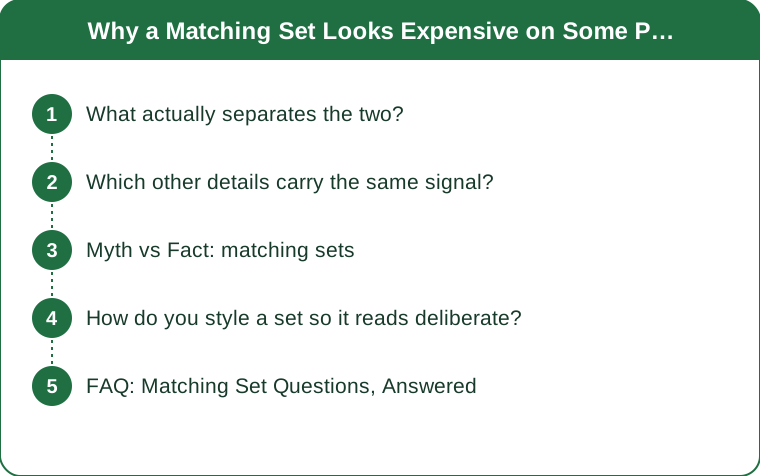
What actually separates the two?
Fabric weight, measured in gsm — grams per square meter — is the strongest single predictor.
Under 220 gsm, fabric is thin enough that it clings to whatever is underneath, shows every seam and texture, and wrinkles into permanent creases at the elbows and knees. This is the weight range most inexpensive sets live in, because fabric is sold by weight and lighter is cheaper.
At 300 to 400 gsm, fabric has enough mass to hang away from the body in a clean vertical line. It holds a shape at the shoulder, resists creasing, and moves as a single piece rather than following every contour.
The visual difference is immediate and reads at a distance, which is why photographs make it so obvious. Heavy fabric photographs like clothing; light fabric photographs like a layer of paint.
Which other details carry the same signal?
Weight is first, but four other things do meaningful work.
Surface sheen. Matte reads expensive; shiny reads cheap in almost every context. Polyester with a visible sheen is the single fastest downgrade available. Look for brushed, peached, or matte finishes.
Rib quality at the cuffs and hem. Cheap sets use thin rib that stretches out permanently within a few wears. Good rib is dense, springs back, and holds the cuff in place. Pull it gently in the store — it should snap back immediately.
Seam finishing. Turn the garment inside out. Flatlock or covered seams mean real construction; raw overlocked edges with loose threads do not.
Color depth. Thin fabric takes dye unevenly and reads washed out. A deep, saturated charcoal or a rich cream signals both fabric quality and dyeing process.
Fit through the shoulder. A set that fits at the shoulder can be oversized everywhere else and still read intentional. One that is oversized at the shoulder reads as too big.

Myth vs Fact: matching sets
Myth: Expensive sets are made of better fabric. Fact: Correlation is weak above a certain price. Plenty of $60 heavy cotton sets outperform $200 thin polyester ones. Read the composition and weight, not the price.
Myth: Cotton is always better than synthetic. Fact: A heavy cotton-poly blend often holds shape better than pure cotton, which bags at the knees and elbows. The enemy is thin and shiny, not synthetic itself.
Myth: Matching sets only work casually. Fact: A heavy knit set in a neutral color with clean loafers and a structured bag is genuinely appropriate for a great many situations that a hoodie is not. The set is doing tailoring’s job in softer fabric.
Myth: Oversized is the current look, so buy up a size. Fact: Oversized works when it is cut oversized. Buying a larger size of a regular cut gives you dropped shoulders in the wrong place and a garment that reads borrowed rather than designed.
How do you style a set so it reads deliberate?
The set does most of the work. The three or four things around it decide the register.
Break up the matching with one contrasting piece. A leather jacket, a denim shirt, or a structured coat over a matching set immediately elevates it. Head-to-toe matching with nothing else reads as loungewear.
Choose shoes from outside the athletic world. Loafers, clean ankle boots, or a mule. Sneakers are fine and are the default — which is precisely why anything else looks more considered.
Add one hard element. A structured bag, a leather belt worn over the top, a watch. Soft fabric plus one hard material is the whole formula.
Keep the color story simple. Two colors maximum in the whole outfit. Sets already occupy two garments; adding a third color fragments the line.
Late summer into fall specifically: swap lightweight sets for brushed cotton, waffle knit, or a wool blend as temperatures drop, and layer a longline coat over the top. The heavier the fabric gets, the more the set reads as an outfit rather than as comfort clothing.
FAQ: Matching Set Questions, Answered
How do I find the gsm if it is not listed?
Many brands publish it in the product details or in a size and fit tab. If not, the physical tell is holding the fabric up to light — if you can clearly see your hand through it, it is too light. Weight in the hand is also reliable once you have compared a few.
Do sets shrink or lose shape?
The thin ones do, quickly. Heavier knits hold up well if you wash cold and dry low or flat. Heat is what destroys rib cuffs and causes the twisted seams that make an old set look old.
Can I wear a set on a plane?
It is close to the ideal travel outfit — comfortable, warm, and it reads put-together on arrival. Choose a matte, wrinkle-resistant blend and skip anything in a light color for a long-haul flight.
Are two-piece sets worth it over separates?
Yes, if the two pieces also work independently. The test before buying: would you wear the top with jeans, and the bottom with a plain tee? If both answers are yes, the set is worth twice what a matching-only set is.
TL;DR:
- Fabric weight is the main signal — under 220 gsm reads cheap, 300+ gsm reads expensive.
- Matte over shiny, dense rib over thin rib, finished seams over raw edges.
- Break the matching with one contrasting layer, non-athletic shoes, and one hard material.
- Buy sets whose halves also work as separates; wash cold and dry low to preserve the rib.
The expensive-looking set in your feed was probably not expensive. It was heavy, matte, and fitted at the shoulder — three things you can check on a product page before you spend anything.
Keep Reading
This article is for general informational and styling purposes only. Fit, sizing, and product availability may vary.