Why Tracksuit Bottoms Pill at the Inner Thigh First — and How to Slow It Down
Quick Answer: The inner thigh pills first because it’s the only place on a tracksuit where fabric rubs against fabric with body weight behind it, thousands of times per walk. Short, weak fibers work loose, tangle into balls, and stay attached. The things that actually slow it are choosing a tighter knit with longer-staple fibers, washing inside out on cold with a reduced spin, skipping fabric softener, and removing pills with a comb or fabric shaver rather than a razor. Once a fabric starts pilling, care slows it — nothing reverses it.
The jacket still looks new. The bottoms have a fuzzy, greying patch between the thighs after two months, and it’s the reason the set stops getting worn.
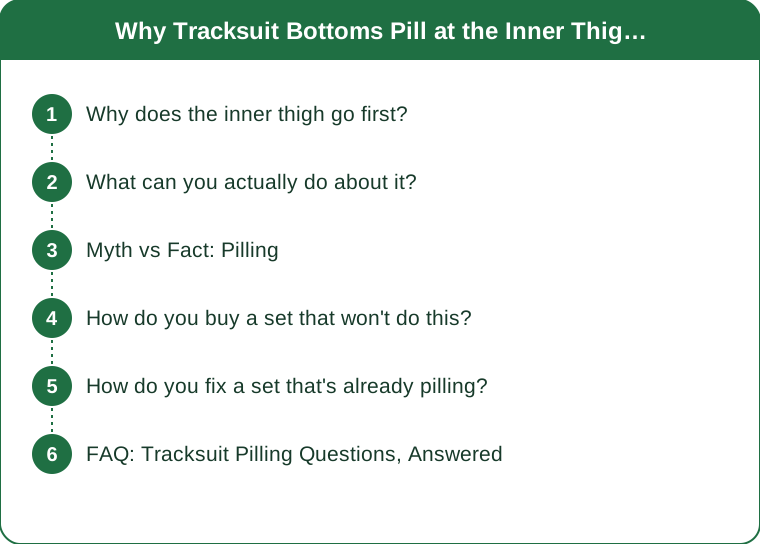
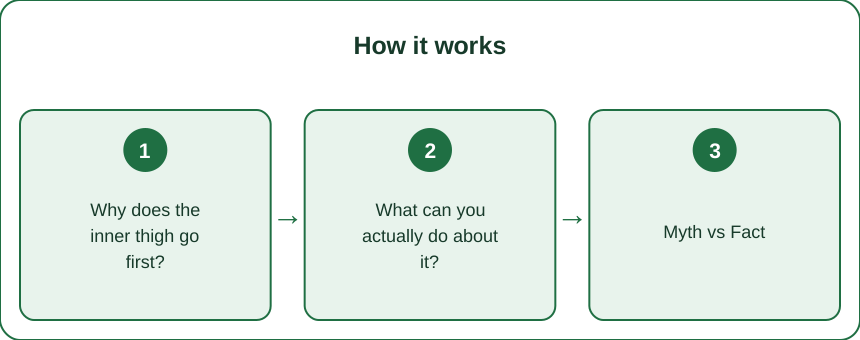
Why does the inner thigh go first?
Because it’s the only fabric-on-fabric friction zone on the garment.
Pilling happens in three stages. Short fibers work their way to the fabric surface, friction tangles them into small balls, and — critically — the balls stay attached because a strong fiber anchors them. This last part is why synthetics pill worse than natural fibers: cotton pills break off, polyester pills hang on.
The inner thigh has every risk factor at once:
- Fabric contacts fabric, not skin or air
- Body weight loads the contact
- The motion is repetitive and identical thousands of times per walk
- Heat and moisture accumulate, which softens fibers and makes them easier to dislodge
No other part of the garment has all four. The seat gets pressure without much motion. The knees get motion without much pressure. The inner thigh gets both, continuously.
Why the jacket looks fine: it has no fabric-on-fabric contact zone, except sometimes at the underarm where a bag strap sits.
Which fabrics fail fastest:
- Loose-knit French terry and low-density fleece: most vulnerable, because fibers are easy to pull loose
- Poly-cotton blends: the polyester holds the pills that the cotton sheds
- Brushed fleece interiors: the brushing process deliberately raises fibers, which is comfortable and pill-prone by design
Which hold up:
- Tightly knit, high-density fabrics — the single biggest predictor
- Long-staple cotton, which has fewer fiber ends to migrate
- Ring-spun rather than open-end yarn
- Merino wool, which has excellent natural pill resistance in a tight knit
What can you actually do about it?
Care changes measurably slow it. Nothing prevents it entirely on a fabric that’s inclined to pill.
Wash inside out, every time. The friction of the wash cycle then hits the inside surface rather than the outside. This is the single highest-value habit and it costs nothing.
Cold water, gentle cycle, reduced spin. Heat and agitation both loosen fibers. A high spin speed adds significant mechanical stress.
Wash with like fabrics only. Denim, towels, and anything with zippers or velcro are abrasive. A tracksuit washed with jeans will pill visibly faster than one washed alone.
Use a mesh laundry bag for the bottoms specifically. It reduces contact with the drum and other garments.
Skip fabric softener. It coats fibers and, in synthetics, tends to make surface fibers slicker and more prone to migrating. It also degrades the moisture-wicking of technical fabrics. Use a wool dryer ball or a splash of white vinegar in the rinse instead.
Air dry, or tumble on low. The dryer is a friction machine. Air drying flat or on a rack is the difference between a garment lasting one season and three.
Wash less often. Tracksuit bottoms worn for a couple of hours around the house don’t need a wash. Every cycle is a pilling event.
Reduce the load size. A packed drum increases fabric-on-fabric contact throughout the wash.
Realistic expectation: these habits can meaningfully extend the useful life of a set. A cheap brushed-fleece bottom will still pill; it’ll just take longer.
Myth vs Fact: Pilling
Myth: Pilling means the fabric is cheap. Fact: Pilling is largely a function of fiber length, yarn construction, and knit density — not price. Expensive cashmere pills readily; inexpensive tightly-knit polyester often doesn’t. Price correlates loosely at best.
Myth: A razor is a good way to remove pills. Fact: A razor cuts fibers rather than removing loose ones, creating new short fiber ends at the surface — which is exactly what starts the next round of pilling. It works once and accelerates the problem afterward. Use a battery fabric shaver or a sweater comb.
Myth: Fabric softener protects fabric. Fact: It makes fabric feel softer by coating fibers, which in many synthetics reduces the fabric’s ability to hold fibers in place and degrades performance finishes. For activewear and tracksuits specifically, it’s counterproductive.
Myth: Once it pills, the garment is finished. Fact: De-pilling with a proper shaver genuinely restores appearance, and a fabric that’s shed its short fibers often pills less afterward. Two or three de-pilling sessions over a garment’s life is normal maintenance, not a rescue operation.
Myth: 100% cotton doesn’t pill. Fact: It does; the pills just fall off more readily because cotton fibers are weaker. What you notice instead is thinning and fading at the same friction zone.
Myth: Turning clothes inside out is a myth. Fact: It’s one of the few laundry habits with an obvious mechanical rationale — the abrasion of the wash lands on the surface facing outward. For pilling-prone garments it’s genuinely effective.

How do you buy a set that won’t do this?
Five checks, all of which you can do in a store in about ninety seconds.
1. The rub test. Rub the fabric against itself, firmly, ten times. If fuzz appears immediately, it will pill within weeks. This is the single most informative thing you can do and almost nobody does it.
2. Check knit density against the light. Hold it up. A dense, tight knit blocks more light and resists fiber migration. A loose, airy knit with visible gaps is a fast-pilling fabric.
3. Read the composition. Look for:
- Higher cotton content with a long-staple designation — pima, supima
- Ring-spun on the label
- Higher fabric weight, typically 300 gsm and above for fleece-type bottoms
- Avoid heavy brushed interiors if durability matters more than immediate softness
4. Feel the inside. A very soft, fuzzy interior is a brushed fabric. It feels wonderful and it’s the most pill-prone construction available. This is a genuine tradeoff, not a mistake — just decide which you want.
5. Check the inner thigh seam. A flat-locked or bonded seam in that zone is far better than a bulky serged one, which adds its own abrasion.
On fiber choices:
- Merino blends resist pilling well and manage odor, at a price
- High-quality polyester in a tight knit is durable if unglamorous
- Cotton-modal and cotton-Tencel blends feel excellent and sit in the middle for durability
- Cheap poly-cotton fleece is the fastest-failing common option
And the honest note: the softest tracksuit in the shop is usually the one that will look worst in three months. Softness at purchase and durability are, in this category, largely opposed.
How do you fix a set that’s already pilling?
It’s more recoverable than most people assume.
Get a battery-powered fabric shaver. They cost around $15 to $25 and work far better than any manual method. Lay the garment flat on a hard surface, pull the fabric taut, and work in one direction with light pressure. Don’t press — pressing pulls the fabric into the blade and can cut holes.
A sweater comb is a good alternative for delicate or looser knits where a shaver risks catching. Slower, safer, and better for wool.
A pumice-style fabric stone works on heavy fleece and denim but is too aggressive for fine knits.
What not to use: disposable razors, which cut and create fresh fiber ends; scissors, for obvious reasons; and tape or lint rollers, which remove nothing that’s actually anchored.
After de-pilling: wash inside out, cold, and air dry. Many garments pill less after the first proper de-pilling because the loose short fibers are simply gone.
When to stop repairing: if the inner thigh is genuinely thin — you can see light through it, or the fabric feels papery — de-pilling will accelerate the wear-through. At that point the bottoms are done, but the jacket usually has years left.
A practical workaround for the mismatch problem: matching sets fail asymmetrically, with the bottoms wearing out long before the jacket. Buying two pairs of bottoms with one jacket, if the brand allows, roughly doubles the useful life of the set and is a much better use of money than replacing the whole thing.
Storage note: fold knits, never hang them. Hanging distorts the shoulders and elongates the waistband over time.
FAQ: Tracksuit Pilling Questions, Answered
Does pilling mean I bought a bad tracksuit?
Not necessarily. It usually means the fabric is a loose or brushed knit, which is what makes it feel soft. Fabric density and fiber staple length predict pilling far better than price does — plenty of expensive sets pill quickly.
Will de-pilling damage the fabric?
A proper fabric shaver used with light pressure on taut fabric removes only the raised pills. Damage comes from pressing hard, working on loose fabric that gets pulled into the blade, or using a razor. Done correctly, it’s safe to repeat several times over a garment’s life.
Why do the bottoms wear out so much faster than the jacket?
The inner thigh is the only fabric-on-fabric friction zone under load on the whole set. The jacket has no equivalent. This is why matching sets almost always fail at the bottoms first, and why buying a spare pair of bottoms is the most efficient purchase in the category.
TL;DR:
- The inner thigh pills first because it’s the only place where fabric rubs fabric under body weight, repeatedly.
- Wash inside out, cold, gentle spin, in a mesh bag, with no fabric softener, and air dry.
- Rub the fabric against itself in the store — if fuzz appears in ten strokes, it’ll pill in weeks.
- Use a battery fabric shaver, never a razor; razors create the short fibers that cause the next round.
The softest set in the shop is usually the one that looks worst by December. Choose knowingly.
Keep Reading
This article is for general informational and styling purposes only. Fit, sizing, and product availability may vary.