Does Your Tracksuit Actually Need Dry Cleaning, or Is That Overkill?
Quick Answer: Most cotton-blend and polyester tracksuits handle a gentle home wash cycle fine despite a ‘dry clean recommended’ label, which is often added for liability reasons rather than genuine fabric necessity — true silk, wool-blend, or structured tailored tracksuits are the main exceptions that genuinely benefit from professional cleaning.
Dry clean recommendations on activewear-adjacent pieces like tracksuits are frequently more conservative than the fabric actually requires, which means many people are paying for cleaning their tracksuit doesn’t strictly need.

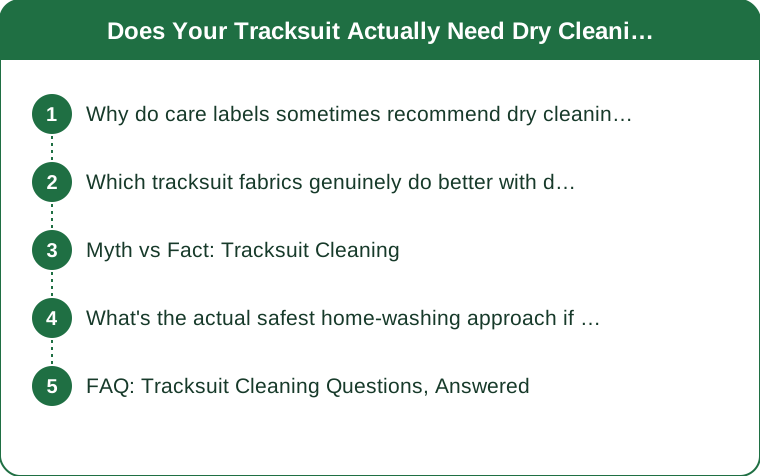
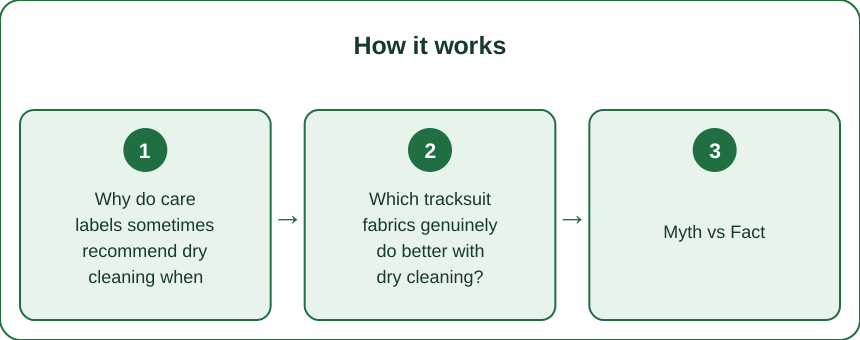
Why do care labels sometimes recommend dry cleaning when it’s not strictly necessary?
Manufacturers often default to a more conservative care label to limit liability for any fabric issue that might arise from home washing, particularly on more expensive or structured pieces, even when the actual fabric composition would tolerate gentle home care reasonably well. This is especially common for tracksuits with any decorative trim, embroidery, or color-blocking, where the label is protecting against edge cases rather than reflecting a hard fabric requirement.
Understanding your specific fabric composition, not just the label’s general suggestion, gives a more accurate picture of what’s actually needed.
Which tracksuit fabrics genuinely do better with dry cleaning?
True silk, wool-blend, and heavily structured or tailored tracksuits with tailoring elements like shoulder padding or structured seams are the pieces where dry cleaning genuinely reduces the risk of shrinkage, color bleed, or structural distortion that home washing can cause. Standard cotton-blend or polyester tracksuits, which make up the large majority of casual and athletic tracksuits, generally don’t have this same risk profile.
Checking the actual fiber content on the label, not just the care instruction, is the more reliable signal here.

Myth vs Fact: Tracksuit Cleaning
Myth: A ‘dry clean recommended’ label always means machine washing will damage the garment. Fact: The label often reflects manufacturer caution rather than an absolute fabric requirement, especially for cotton-blend and polyester pieces.
Myth: Hand washing is always safer than machine washing for any tracksuit. Fact: A gentle machine cycle in a mesh bag is often just as safe as hand washing for standard tracksuit fabrics, and considerably less time-consuming.
Myth: Dry cleaning is always better for preserving color vibrancy. Fact: Cold water machine washing with color-safe detergent preserves vibrancy just as well for most standard tracksuit fabrics, without the added cost.
What’s the actual safest home-washing approach if you decide to skip dry cleaning?
Cold water, a gentle cycle, and a mesh laundry bag minimizes friction and color transfer risk, while air drying rather than machine drying prevents the shrinkage and fabric distortion that heat exposure can cause over repeated washes. Turning the tracksuit inside out before washing also protects any printed graphics or embroidery from direct abrasion against other items in the wash.
This approach handles the vast majority of standard tracksuit fabrics safely, reserving dry cleaning for the genuine structured or delicate-fabric exceptions.
FAQ: Tracksuit Cleaning Questions, Answered
How can I quickly check my tracksuit’s actual fiber content?
The fiber content is typically listed on the same care label as the wash instructions, usually as a percentage breakdown (e.g., ‘80% cotton, 20% polyester’).
Is it risky to ignore a dry clean label entirely without testing first?
Testing a small, hidden seam area with a damp cloth and mild detergent before a full wash is a reasonable low-risk way to check for colorfastness before committing.
Does washing at home void any warranty on a higher-end tracksuit?
Some premium brands do specify care requirements tied to warranty coverage, so it’s worth checking brand-specific policies for higher-cost pieces specifically.
TL;DR:
- Dry clean labels are often added for manufacturer liability, not strict fabric necessity
- Standard cotton-blend and polyester tracksuits generally handle gentle home washing fine
- True silk, wool-blend, and structured tailored tracksuits are the genuine exceptions worth dry cleaning
- Cold water, a gentle cycle, a mesh bag, and air drying is the safest home-washing approach
Check the actual fiber content before assuming dry cleaning is required — many tracksuits are safe for a gentler, cheaper home wash.
Keep Reading
This article is for general informational and styling purposes only. Fit, sizing, and product availability may vary.